Understanding the current value of a player relative to their future one helps make compromises when trading these assets.
Net Present Value for Dynasty League Formats
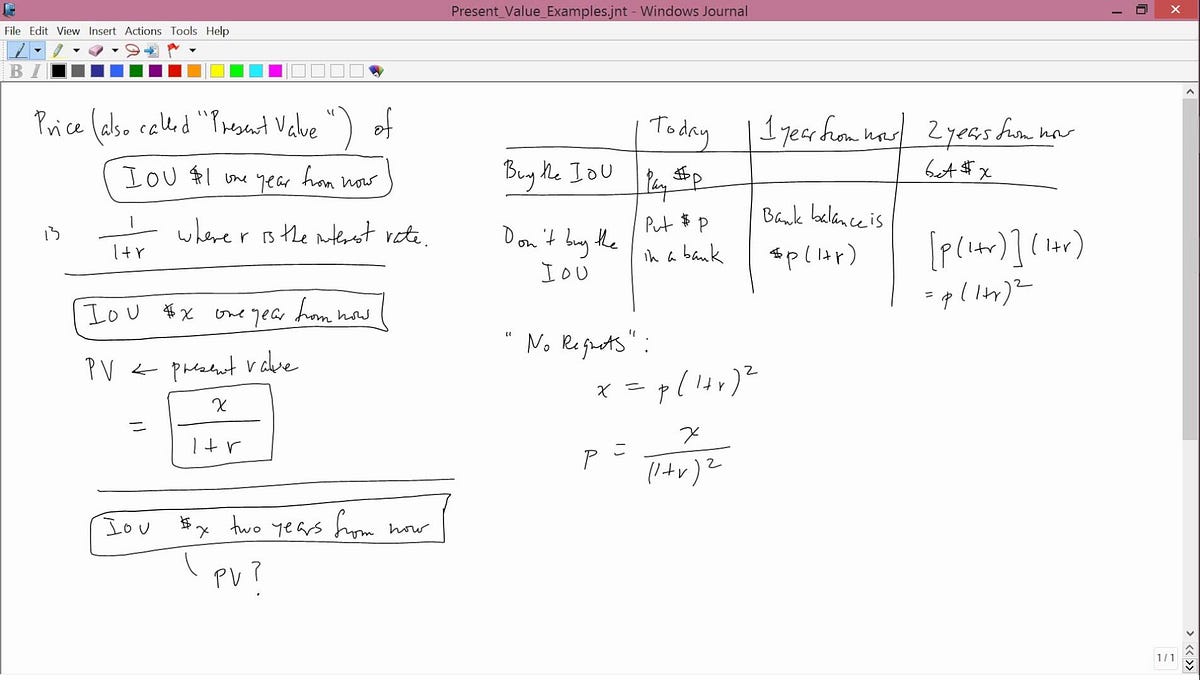
Formula for evaluating present versus future value tradeoffs.
In dynasty/keeper fantasy football leagues there is a balance between value of this season versus value in future seasons. The financial concept of Net Present Value is one that needs to be understood to evaluate trades.
In our PAFFL league, we have a complex contractual system that allows teams to keep players up to 6+ years. There is a set salary cap ($500 a year) that allow teams to commit players to long-term contract. The question comes up every year, is this one season of say Adrian Peterson (assume he’s retiring at the end of ’16) worth more than the next three seasons of David Johnson? In short what is the short vs. long term value of fantasy football player.
One of our league owners, Black Liberace (aka Jack Tripper), posted this in comment form today and I felt it was worthy of its own post. What’s important — and was pointed out to me by another fellow PAFFL member on Saturday night, is that the league has gone towards overvaluing future potential to the point of being disinterested in current performance.
Fantasy Football Net Present Value 101. The discount rate is a measure of risk — how much should you discount an investment’s value into the future, with the rate directly correlating with the risk (ie higher risk higher rate). There is no formal discount rate in football — while in the real world there are proxies like the LIBOR or T-bill rates. VC’s use discount rates up to 40% to gauge investments, while AAA bond investors use the Fed rate which is something like 5% right now.
Consider the question — what is the value of the DS spot on a $55 player? It is $25 three years out — because in three years you will have one more year at $55 instead of $80, a difference of $25. Depending on your discount rate, that $25 three years out can be thought of to be about $20 or $5 in today’s terms. (If you want to get all economist on me, you can argue that since we don’t have inflation (ie the PAFFL money supply is fixed) the discount rate is a flawed measure because a PAFFL dollar today will get me roughly the same projected point production that a PAFFL dollar tomorrow will. I would respond by saying that while it’s flawed, the principle of discounting for the future is the best way to account for the risk and uncertainty of the game).
The NFL is as risky as it gets — player performances can vary wildly over games and seasons, last year’s MVP can be this year’s bust and vice versa. I put the NFL discount rate as high as the riskiest financial investments, so I value the $55 DS as about $5 in today’s terms…even if you think you there is zero risk and there shouldn’t be any discount, you are still only talking about $25.
So, to complete the answer to the question, what is the value of the DS spot on a $55 player? We have established that the potential investment value is from $5-$25, but that does not factor in the costs. If it’s a QB like JaMarcus Russell that is not going to score any points during their DS year, there is no “cost” associated. But if it’s a player like Adrian Peterson, who is averaging about 12 points a game right now, then that is your cost, 12 points/game. You are saving $2 in cap space three years out for every point/week you are sacrificing. I’m not a genius, but that doesn’t seem like a very good investment to me. Suffice to say that if I hadn’t traded him away I would not be keeping him DS’d on the bench, even if I was 1–4 like Short Bus and throwing in the towel.
What’s interesting is the argument for and against developing players. I’ve always believed that a player needed experience to reach their potential, and outside of the QB position, if said player wasn’t receiving the necessary playing time they weren’t wasting a roster spot on. However there are exceptions. The important point is production today is worth more than potential tomorrow, and if the balance shifts too much one way or the other, it’s crucial to take advantage.
Major kudos to fellow fscollective member Jack Trippers for originally writing and contributing the above piece.
